
Choosing the right security team for your New York City event takes more than comparing hourly rates. An unlicensed or uninsured provider can expose your event to unnecessary liability and create problems at the door.
In this guide, you’ll learn how to hire event security guards by assessing your event’s risks, verifying licensing and insurance, and confirming the right coverage plan before you book.
What You Need Before You Start
Before contacting any security provider, define your event’s size, venue type, alcohol service, and expected crowd behavior, since this determines the guard count and skill level you need.
Requirements, Conditions, or Information Needed
Write down your guest count, venue layout, entry points, and whether you will serve alcohol. A rooftop lounge with a bar and a 300-person guest list needs a different security plan than a daytime corporate conference.
Note any past incidents at the venue and whether the event is open to the public or invitation-only. Having these details ready lets a licensed provider quote accurately instead of guessing.
Step-by-Step: How to Hire Event Security Guards for Your Event
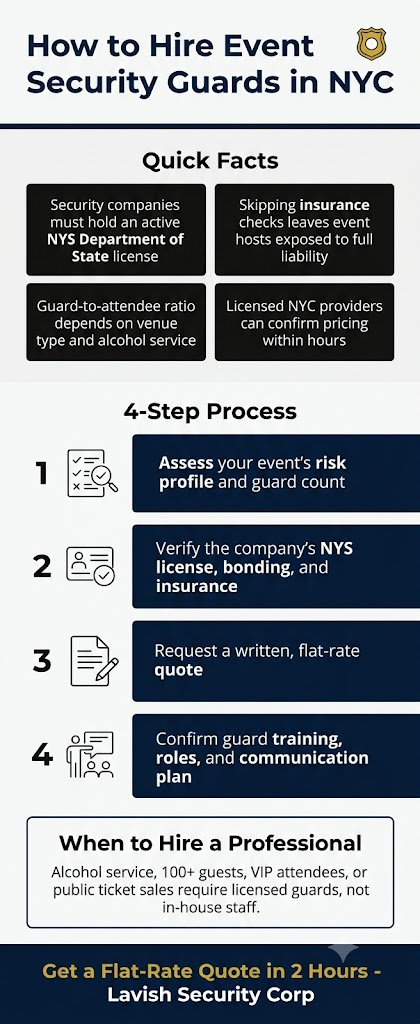
Hiring the right team takes four steps: assess your risk, verify the company’s license and insurance, request a customized quote, and confirm guard roles before the event date.
To hire event security guards in New York City, first assess the venue’s risk level and expected crowd size. Next, confirm the company holds an active New York State Department of State license and current liability insurance.
Then request a written, flat-rate quote scoped to your event. Finally, confirm guard assignments and communication protocols before the event date.
Step 1: Assess Your Event’s Risk Profile and Required Guard Count
Start by matching guard count to venue size, alcohol service, and expected crowd energy. A corporate office event with fifty attendees and no alcohol needs far less coverage than a five-hundred-person nightlife event with a full bar.
The global security services market was valued at 156.2 billion dollars in 2025, projected to grow at a 6.9 percent annual rate, according to Grand View Research, reflecting steadily rising demand for professional, trained coverage rather than informal staffing.
Step 2: Verify the Company’s NYS License, Bonding, and Insurance Coverage
This is the step most event hosts skip, and it is the one that matters most. Every security guard company operating in New York must be registered as a Watch, Guard, or Patrol Agency with the New York State Department of State.
Every guard on-site must complete state-mandated pre-assignment and on-the-job training before deployment, as per the New York State Department of State. Ask the company for its license number, then confirm it directly through the Department of State’s public licensing lookup.
Also request proof of general liability insurance, workers’ compensation coverage, and assault and battery coverage. A provider that hesitates to produce these documents is not the right fit for your event.
Step 3: Request a Customized, Flat-Rate Quote and Written Scope of Coverage
Once licensing is confirmed, ask for a written quote that lists guard count, shift hours, and specific duties such as entry screening or alcohol monitoring. A flat-rate structure protects you from surprise charges after the event.
Avoid providers who quote a single hourly number without describing what that rate actually covers.
Step 4: Confirm Guard Training, Roles, and Day-of Communication Protocol
Before the event, confirm who is running point on-site, how guards will communicate with your event staff, and what the escalation plan looks like if a guest becomes disruptive.
Clear roles prevent confusion in the moment that matters most.
When This Becomes a Job for a Professional
In-house staff or unlicensed help can handle low-risk gatherings, but licensed guards become essential once alcohol, large crowds, or public access enter the picture.
Signs Your Event Needs Licensed Coverage, Not In-House Staff or Unlicensed Help
If your event involves alcohol service, a guest list of over one hundred people, VIP attendees, or public ticket sales, in-house staff without state licensing cannot legally perform guard duties such as searches or removals.
Venues that fail to manage crowds properly also carry real legal exposure.
Because most U.S. jurisdictions have no specific crowd-safety statute, inadequate crowd management at an event is typically evaluated under common-law negligence, placing the liability burden on the venue or host, as per the Pearl, Kentucky Law Journal.
One randomized study of security patrols found a measurable drop in incidents at locations with trained personnel compared to locations without dedicated coverage, according to Ariel et al., though that research focused on transit settings rather than private events specifically.
The same principle of trained presence applies directly to crowd-heavy venues.
How Lavish Security Corp Approaches Event Security Hiring
Lavish Security Corp is fully licensed, bonded, and insured under the New York State Department of State, with a team built from military and law enforcement backgrounds.
The company has covered more than 500 events across all five boroughs and secured over 150 client sites, building each security plan around the specific venue, guest list, and alcohol service involved rather than a standard package.
New clients typically receive a flat-rate quote within two hours of their first inquiry, so event planning does not stall while waiting on pricing.
Frequently Asked Questions
Q1. How much does it cost to hire event security guards in NYC?
Cost depends on guard count, shift length, and whether armed coverage is needed. Providers using a flat-rate model give you the full cost upfront instead of an hourly estimate that can change after the event.
Q2. What license should a security guard company have in New York?
A security guard company operating in New York State must hold a Watch, Guard, or Patrol Agency license from the New York State Department of State and every guard must complete state-mandated pre-assignment and on-the-job training before working an event.
Q3. How many security guards do I need for my event?
Guard count depends on your venue size, guest count, alcohol service, and entry points. A licensed provider will calculate this ratio after reviewing your specific event details rather than applying a fixed number to every booking.
Q4. Can I hire security guards for a single event only?
Yes. Licensed NYC security companies commonly offer single-event contracts alongside short-term and long-term coverage, so you are not required to sign a permanent agreement to secure one event.
Q5. How quickly can I get a security guard company confirmed for my event?
Lavish Security Corp typically replies with a flat-rate, no-hidden-fee quote within two hours of an initial inquiry, so a licensed provider can be confirmed for single-event, short-term, or long-term coverage without delaying the rest of your event planning.
Conclusion
Hiring the right security team can make your NYC event safer, more organized, and easier to manage. Before you hire security guards for an event, assess your crowd and venue, verify the provider’s license and insurance, request a clear written quote, and confirm guard responsibilities.
Ready to plan reliable coverage for your next event? Contact Lavish Security Corp to hire security guards for your event and request a customized, flat-rate quote based on your venue, guest count, and security needs.