
Choosing personal protection services in New York City requires more than comparing prices. Businesses, property managers, and event planners need to verify licensing, insurance, training, and whether the provider can tailor protection to their specific risks.
In this article, you’ll learn five questions to ask before hiring a personal protection provider. These checks can help you choose a qualified, accountable security team and reduce avoidable liability.
Quick Answer: Verify licensing, insurance, training, customization, and contract terms before hiring personal protection services.
How These Personal Protection Services Questions Were Selected
Quick Answer: These five questions reflect what New York State requires of licensed agencies and what an informed buyer should confirm before signing a security contract.
New York State regulates a large private security workforce, and most NYC businesses across corporate, hospitality, and event sectors will face a hiring decision like this at some point.
New York employed well over 100,000 security guards statewide, based on the most recently published state-level data, and the licensing framework governing that workforce has not changed since, as per the Bureau of Labor Statistics.
The questions below reflect documented state requirements and informed-buyer standards, not generic advice repeated across the industry.
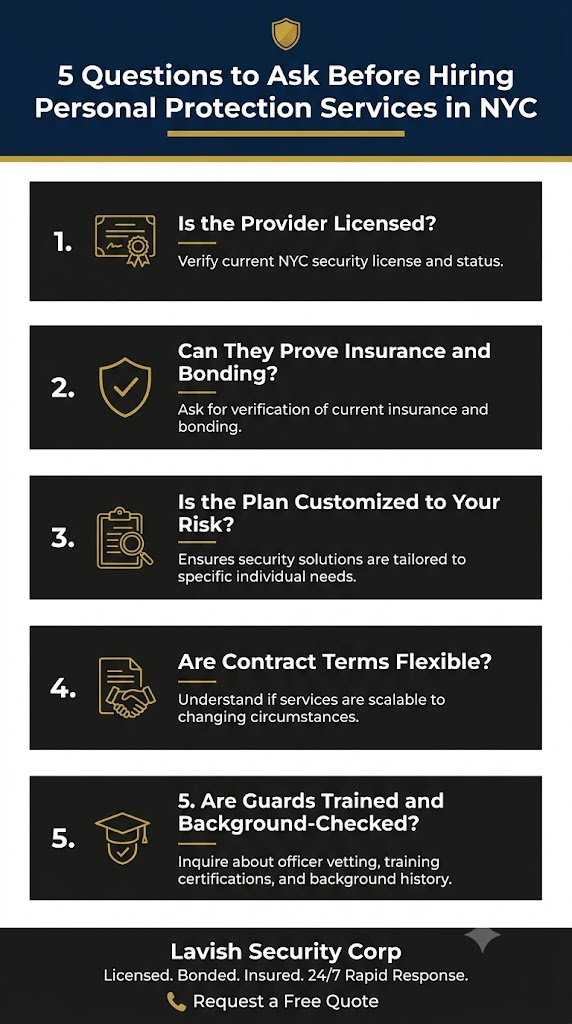
1. Is the Provider Fully Licensed by the NYS Division of Licensing Services?
Quick Answer: A licensed agency must register with the New York State Department of State, carry a surety bond, and meet minimum insurance requirements before deploying any guard.
Every watch, guard, or patrol agency operating in New York State must hold a license, carry a $10,000 surety bond, and provide proof of liability insurance before assigning guards to a site, as per the NYS Department of State.
A business that hires an unlicensed provider carries that compliance risk directly, including potential exposure if an incident occurs on the property.
Lavish Security Corp. is fully licensed, bonded, and insured under this exact standard, which is the first proof point any provider should be able to produce on request.
What the license actually covers
The agency license and the individual guard registration are two separate requirements. You should confirm both are current before you place a guard on your site.
Best for
This question matters most for property managers and business owners who cannot absorb liability from an unlicensed vendor.
One honest limitation
A license confirms legal compliance. It does not guarantee guard skill or judgment on site, so licensing is the floor, not the full picture.
2. Can They Prove Bonding and Insurance Coverage?
Quick Answer: A provider should produce certificates for general liability, workers’ compensation, and assault and battery coverage without hesitation.
What proof to request
Ask for current certificates covering general liability, workers’ compensation, and assault and battery coverage. These three types form the baseline for a properly insured security operation.
Why this matters more than it seems
When a property or venue relies on inadequately vetted security, legal and financial exposure can escalate quickly, particularly at venues managing crowds or guest behavior.
Rising claims costs and reporting delays have contributed to a harder insurance market for security operations, according to ASIS International. That trend makes verified coverage, not a verbal assurance, the safer standard to insist on.
Best for
Venues and event organizers carrying crowd-related liability exposure benefit most from confirming this upfront.
One honest limitation
Coverage minimums vary by provider, so request certificates directly rather than accepting a verbal assurance.
3. Is the Security Plan Customized to Your Specific Risk Profile?
Quick Answer: A generic guard-post assignment is different from a plan built around your building, event, or venue risk profile.
What genuine customization includes
A real risk assessment covers coverage hours, guard count, access points, and the specific threats tied to your property or event type.
Best for
Corporate, government, and construction sites with unique access-control needs get the most value from a customized approach.
One honest limitation
Genuine customization requires an on-site assessment. A phone-only quote without a site visit usually signals a standardized package, not a tailored plan.
4. Do They Offer Flexible, Transparent Contract Terms?
Quick Answer: Flexible engagement terms, backed by a fast and clear quote process, show a provider can scale to your actual need instead of forcing you into a fixed package.
What flexible terms look like
Short-term, long-term, single-event, and permanent site coverage should all be available as distinct options, not variations of one rigid contract.
Best for
Event planners and businesses needing rapid, non-locked-in deployment benefit most from this flexibility.
A readiness signal worth checking
A provider able to return a flat-rate quote within two hours signals established staffing and clear pricing, instead of leaving you waiting on a callback. Licensing, insurance, customization, and contract terms are usually addressed as separate questions across most hiring guides. Treating them as one connected conversation gives you a clearer basis for comparing providers.
5. Have Guards Completed State-Mandated Training and Background Checks?
Quick Answer: Training and background checks are the regulatory baseline, and a real vetting conversation should confirm this directly rather than assume it.
Training and background-check requirements
Registered guards in New York State must complete 8 hours of pre-assignment training and 16 hours of on-the-job training, along with a criminal background check, according to the NYS Department of State.
Best for
Hospitality and nightlife venues needing staff trained in de-escalation and entry screening benefit most from confirming this step.
One honest limitation
Training sets a floor, not a guarantee of field experience.
A measurable reduction in reported crime has been linked to a consistent, trained security presence in a peer-reviewed field study drawing on 2017 findings, the most directly applicable data available on this point, according to the National Library of Medicine research database.
That supports asking about deployment consistency, not just training hours on paper.
Frequently Asked Questions
Q1. What license does a security company need to operate in New York City?
A security company operating in New York City needs a Watch, Guard, or Patrol Agency license from the New York State Department of State, along with individual guard registration for every officer deployed.
Q2. How much liability insurance should a security guard company carry?
A security guard company should carry general liability, workers’ compensation, and assault and battery coverage at minimum, with certificate proof available on request before any contract is signed.
Q3. Can a personal protection service cover a single event instead of a long-term contract?
Yes. Reputable providers typically offer single-event coverage alongside short-term, long-term, and permanent site contracts, so the engagement matches the actual need instead of a fixed package.
Q4. What is the difference between a licensed guard and a licensed agency?
A licensed guard is an individually registered officer, while a licensed agency is the business entity authorized to employ and deploy guards. Both registrations must be active and current.
Q5. How quickly should a security provider respond with a quote?
A well-staffed provider can typically return a flat-rate quote within a few hours of an inquiry, since pricing depends on guard count, hours, and site risk rather than lengthy back-and-forth.
Make the Decision With Documentation, Not Assumptions
Choosing personal protection services in New York City requires more than comparing rates. Verify the provider’s licensing, insurance, training, contract terms, and ability to build a protection plan around your specific risks.
These checks help you choose a security partner that is prepared to protect your people, property, and business. Lavish Security Corp. provides personal protection services tailored to the needs of businesses, executives, and high-profile clients in New York.
Request a personalized proposal today to discuss your security needs and build a protection plan for your specific situation.