
Before hiring venue security services in NYC, verify more than a guard’s registration card. You also need to check training, venue experience, alcohol-service procedures, and contract terms. A registered guard may still lack the experience needed to manage a crowded entrance or de-escalate a dispute.
In this guide, you’ll learn eight criteria for comparing security providers, from licensing and training to customized plans and quote clarity.
Quick Answer: Check registration and insurance first, then training, venue experience, alcohol-service handling, plan fit, and pricing.
What You Need Before You Start
Quick Answer: Gather your venue facts first, because a provider can only customize a plan to risks you can describe.
Information to gather about your venue
List your capacity, entry points, alcohol service hours, and event types. Note past incidents, such as door disputes, overcrowding, or intoxicated guests. Also estimate how many guards you need on a typical night and on your busiest night. A security provider needs these details to build a plan around your actual risk profile.
Then request documents before the first meeting: proof of New York State licensing, bonding, and insurance. A provider that hesitates to share them has already answered an important question.
Step-by-Step: Evaluating Venue Security Services Before You Sign
Quick Answer: Work through four steps in order, because each step filters out providers before you spend time on the next.
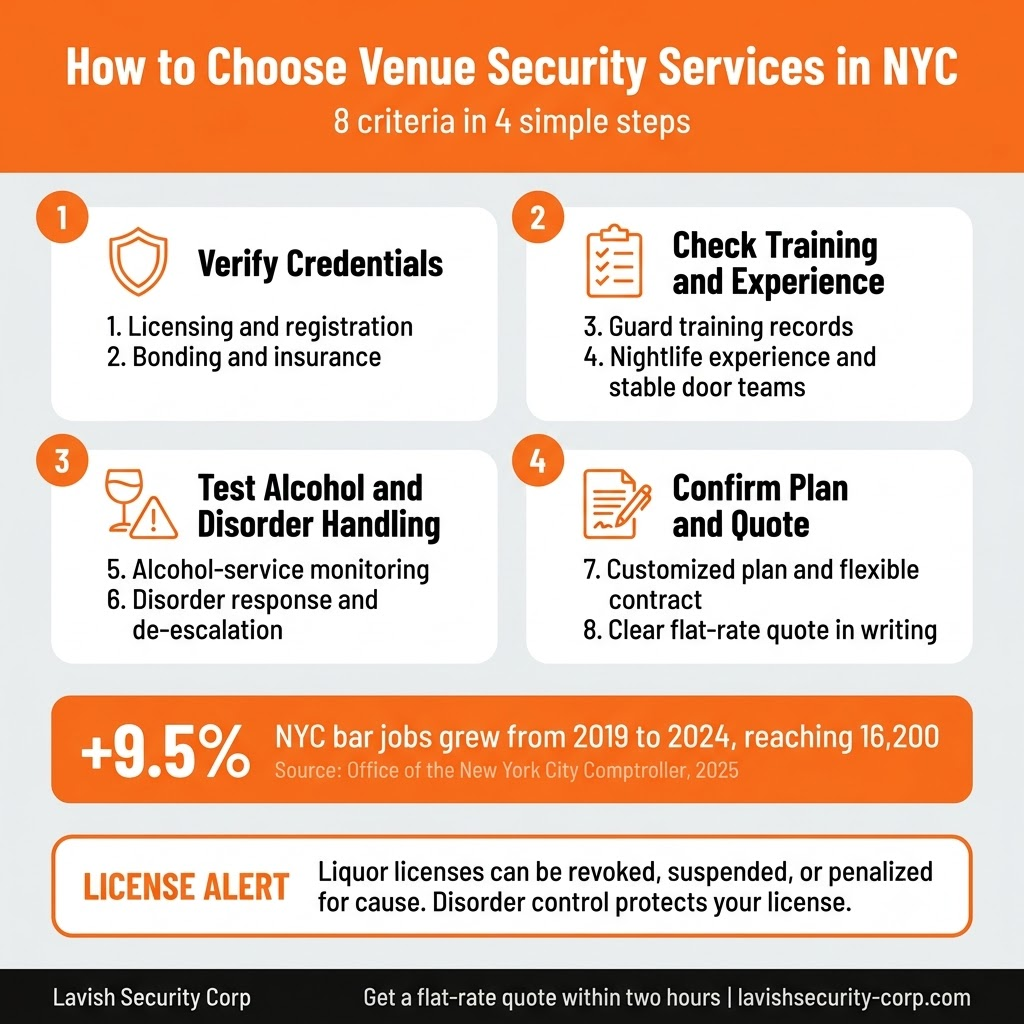
To choose a venue security provider in NYC, confirm registration, bonding, and insurance first. Then check training and nightlife experience. Next, test how guards handle alcohol service and disorder. Finally, confirm that the plan, contract, and quote match your venue.
Step 1: Verify licensing, registration, and bonding
Criterion 1 is licensing and registration. Every person engaged in security guard activities must register under Article 7-A and complete required training, according to the New York State Department of State.
Criterion 2 is bonding and insurance. Request written proof of both, and ask exactly which coverages each policy includes. The NYS Department of State licenses Lavish Security Corp., which also carries bonding and insurance.
Step 2: Check guard training and hospitality experience
Criterion 3 is guard training. Ask for training records for every guard, not general assurances.
Criterion 4 is hospitality experience and staffing stability. Ask how long the provider has worked in nightlife, because a club door faces different pressure than an office lobby.
Stability matters too. Bars and clubs with higher turnover of trained door staff and managers had significantly higher levels of severe aggression after the Safer Bars program than those with lower turnover, as per the City of Toronto. That finding suggests a stable door team matters.
Lavish Security Corp draws its teams from hospitality and nightlife backgrounds and from military and law enforcement training.
Step 3: Test how the provider handles alcohol service and disorder
Criterion 5 is alcohol-service monitoring, and criterion 6 is disorder response. Registration shows a guard works legally. It does not show a guard can help protect your license.
The Liquor Authority may revoke, cancel, or suspend a license, or impose a civil penalty, for cause, according to the New York State Alcoholic Beverage Control Law, Section 118. In practice, that makes disorder control a license issue, not only a safety issue.
Ask each provider four questions.
- How do guards monitor alcohol service and guest behavior?
- Who decides when to refuse entry?
- How do guards de-escalate a dispute?
- How do they document an incident?
The company covers alcohol service monitoring, entry point control, crowd flow, and emergency de-escalation through its event security service. The license belongs to you, so guards support your compliance without replacing it.
Step 4: Confirm plan customization, contract terms, and quote clarity
Criterion 7 is plan customization and contract flexibility. Ask whether the provider builds the plan around your venue or hands you a generic package. Confirm that the contract fits your calendar.
Criterion 8 is quote clarity. Request the price in writing as a flat rate and ask what it excludes. Lavish Security Corp offers short-term, long-term, single-event, and permanent site coverage, and it quotes with no hidden fees.
When Venue Security Becomes a Job for a Professional
Quick Answer: If you cannot verify licensing, training, and alcohol-service handling yourself, bring in a licensed provider.
Signs the task is beyond safe in-house scope
Some warning signs show up early. Watch for these three gaps in your current coverage:
- Door staff work without state registration or training records.
- One person covers both the door and the bar on busy nights.
- No written process exists for refusing entry or reporting an incident.
Any one of these gaps puts your license compliance and your guests at risk. A licensed provider can address them with verified registration, documented training, and a written incident process.
How Lavish Security Corp handles venue security
Lavish Security Corp operates from the Bronx and serves Manhattan, Brooklyn, Queens, Staten Island, and Long Island. The company reports 150+ client sites secured and 500+ events covered across NYC. Its restaurant and nightlife security service pairs trained guards with a plan customized to each venue’s risk profile.
Frequently Asked Questions
Quick Answer: These answers cover registration, vendor questions, license risk, and quotes.
Q1. What registration must venue security guards hold in New York?
Guards in New York must register under Article 7-A, according to the New York State Department of State. Ask the provider to show each guard’s registration and training records before that guard works your door. A provider that cannot produce them gives you a reason to look elsewhere.
Q2. What should you ask a venue security company before signing?
Ask for proof of licensing, bonding, and insurance; guard training records; nightlife experience; an alcohol service and de-escalation protocol; a customized plan; and written pricing with exclusions.
Documents give you a firmer basis for a decision than assurances, and a confident provider shares them before you sign.
Q3. What does the State Liquor Authority expect of licensed venues on disorder?
The Liquor Authority can revoke, cancel, or suspend a license, or impose a civil penalty, for cause, according to the New York State Alcoholic Beverage Control Law, Section 118. Disorder at a venue can put the license at risk. Guards support your compliance, but the license and its risk stay with you as the holder.
Q4. How fast can you get a flat-rate quote from Lavish Security Corp?
The team sends a flat-rate quote within two hours, and the quote carries no hidden fees.
Q5. Can you book coverage for a single event?
Yes. Lavish Security Corp offers single-event coverage alongside longer terms.
Conclusion
The right security provider should give you clear evidence of licensing, training, venue experience, and coverage terms before you sign. Compare those details alongside alcohol-service procedures and written pricing to make a confident decision.
Ready to secure your venue? Send Lavish Security Corp your venue address, capacity, event date, operating hours, and crowd details to get a customized flat-rate quote within two hours.