
Choosing between in-house staff and professional security guards can affect your NYC business’s safety, costs, and legal responsibilities. Property managers and event planners must consider licensing, training, insurance, and who handles security when coverage gaps arise.
In this article, we compare both options to help you choose the right security model for your property or event.
Quick Comparison: Professional Security Guards vs. In-House Staff Coverage
Quick Answer: Licensing, insurance, training, and cost structure separate an agency guard from an in-house hire.
The table below lines up the two models on the criteria that most affect a New York City business owner’s decision.
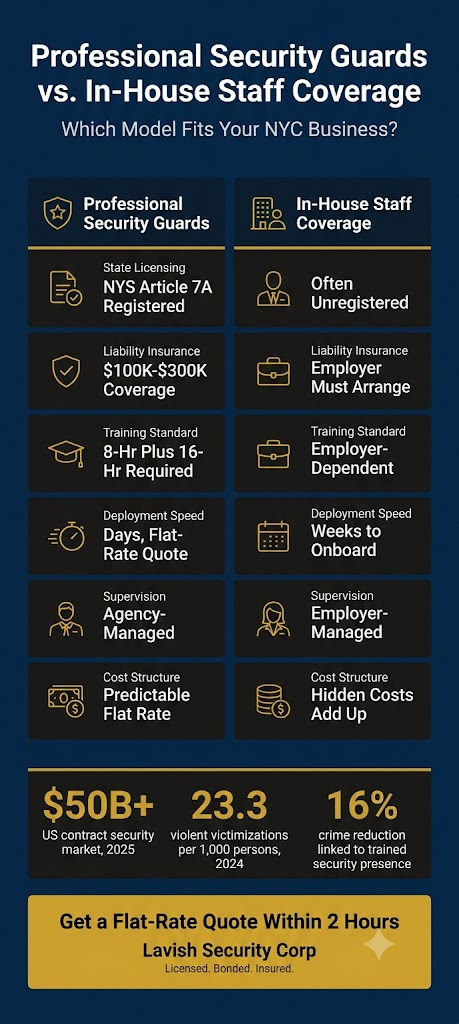
| Factor | Professional Security Guards (Agency) | In-House Staff Coverage |
| State licensing | Agency and guards registered under NYS Executive Law Article 7A. | Often unregistered unless the employer completes the process independently |
| Liability insurance | The agency typically carries a $100,000 to $300,000 coverage floor. | The employer must arrange and fund equivalent coverage. |
| Training standard | 8-hour pre-assignment plus 16-hour on-the-job training built into onboarding. | Depends entirely on what the employer builds internally. |
| Deployment speed | Guards can be assigned within days under a flat-rate quote. | Hiring, vetting, and training can take weeks before coverage starts. |
| Supervision | The agency manages scheduling, performance, and replacement of staff. | The employer manages scheduling, discipline, and turnover directly. |
| Cost structure | Predictable flat-rate billing with no hidden fees | Lower sticker wage, but recruiting, training, and insurance costs add up separately. |
What Lavish Security Corp Does Best
Quick Answer: Lavish arrives pre-licensed, pre-insured, and pre-trained, so compliance is already handled before a guard reaches your site.
Lavish Security Corp is fully licensed, bonded, and insured, and every guard placed on a site or at an event has already cleared New York State’s registration and training requirements before their first shift.
Businesses do not need to build a compliance program from scratch or track renewal deadlines themselves. That work is already done.
NYS Licensing, Bonding, and Insurance Compliance
New York State requires every security guard to register with the Department of State’s Division of Licensing Services and complete state-mandated training before working a single post, according to the NYS Department of State.
Licensed agencies operating under a Watch, Guard, or Patrol Agency license must also carry liability insurance, commonly in the $100,000 to $300,000 range, as confirmed by the NYS Department of State.
When a business staffs security in-house without going through a registered agency, that compliance and insurance burden does not disappear. It transfers directly to the employer, along with the liability if something goes wrong on the property.
The U.S. contract security market topped $50 billion in 2025, growing at roughly a 4.7 percent compound annual rate, according to Robert H. Perry and Associates. This growth reflects more businesses shifting the compliance burden to licensed providers rather than building it internally.
Military and Law Enforcement-Trained Personnel
Lavish’s guards come from military and law enforcement backgrounds, so training is not limited to the state minimum. Officers are trained in de-escalation, emergency response, and CPR and first aid and know how to read a situation before it escalates.
This matters most in the moments a generic hire has not been prepared for: a crowd surge at an entrance, an intoxicated guest becoming aggressive, or an unauthorized person accessing a restricted area.
Visible, trained security patrols were linked to a 16 percent reduction in victim-generated crime at monitored locations, according to Ariel, Bland, and Sutherland, PLoS One. That study examined civilian patrol staff rather than military or law enforcement-trained officers like Lavish’s guards.
Flexible, Customized Engagement Models
Every property and event carries a different risk profile, so Lavish builds coverage around the specific site rather than issuing a standard package.
Contracts run short-term, long-term, single-event, or permanent, and Lavish replies with a flat-rate quote within two hours of a request. You know the cost upfront, with no hidden fees added later.
What In-House Staff Coverage Offers
Quick Answer: In-house staff bring property familiarity, but the employer absorbs every compliance and liability responsibility a licensed agency would otherwise carry.
In-house security staff are employees hired directly by the business rather than supplied through a licensed agency. They tend to know the property layout, the regular tenants or guests, and the daily routine better than an outside guard on a first assignment.
Hourly wages for in-house staff can look lower on paper than an agency’s flat rate. The employer is responsible for recruiting, background checks, training, licensing compliance, scheduling, and liability insurance, none of which come bundled the way they do with a licensed agency.
Coverage gaps during illness, turnover, or vacation also fall on the employer to solve directly.
The Key Differences That Matter
Quick Answer: The real gap is not hourly wage; it is who carries the licensing, insurance, and liability responsibility.
Licensing and Liability Exposure
Yes, in-house staff know the property, but without NYS Article 7A registration and agency-level insurance, the employer carries full liability if an incident occurs on-site. This risk is not theoretical.
An estimated 23.3 violent victimizations per 1,000 persons were reported in 2024, according to the Bureau of Justice Statistics. Properties without licensed protection carry that baseline risk with no compliance safety net behind them.
True Cost Comparison
Yes, in-house staffing can look cheaper per hour, but recruiting, background checks, training, supervision, workers’ compensation, and liability insurance are costs a licensed agency already absorbs into its flat-rate quote.
Once those line items are added up, the gap between the two models narrows considerably, and the employer is still the one holding the liability if training falls short.
Which Option Is Best for You?
Quick Answer: The right choice depends on your risk exposure and whether you want compliance managed internally or by a licensed provider.
In-house staff coverage best fits single-location businesses with very low risk exposure that are prepared to build and manage their own licensing, training, and liability program internally and that have the internal resources to keep that program current as NYS requirements change.
Professional security guards from Lavish Security Corp best fit NYC businesses, property managers, and event planners who need licensed, insured, and trained guards deployed quickly without absorbing the compliance and liability burden themselves.
Frequently Asked Questions
Quick Answer: These are the licensing, cost, and liability questions NYC business owners ask most before choosing between in-house and agency security.
Q1. Is it legal to use in-house security staff instead of a licensed guard company in New York?
Yes, but the business must independently meet the same NYS registration and training requirements a licensed agency already satisfies. Skipping this step exposes the business to liability if staff lack proper registration.
Q2. How much does it cost to staff in-house security versus hiring a licensed security company?
In-house wages may look lower per hour, but recruiting, training, licensing, and insurance add costs a licensed agency’s flat-rate quote already includes. The true cost gap is usually smaller than the wage comparison suggests.
Q3. What insurance is required for security guards operating in NYC?
Licensed Watch, Guard, or Patrol agencies typically carry liability coverage in the $100,000 to $300,000 range as a baseline requirement, according to the NYS Department of State. Businesses staffing in-house must arrange equivalent coverage themselves.
Q4. Can in-house security staff carry the same liability protection as a licensed provider?
Only if the employer independently builds a program matching state licensing, training, and insurance requirements. Without that program, liability protection is weaker than what a licensed agency provides by default.
Conclusion
Choosing between in-house staff and a licensed security company ultimately comes down to where you want the responsibility for licensing, training, insurance, and liability to sit. With a professional provider, those requirements are already built into the security program, allowing your business to focus on its operations.
Need reliable coverage without building a security program from scratch? Request a flat-rate quote from Lavish Security Corp today and get a response within two hours.