
What does a security quote include, and what does it leave out? Corporate security services in NYC combine licensed guards, a site-specific security plan, and defined coverage hours. Each element affects the scope and cost of a contract. A quote that states only an hourly rate leaves you to calculate the rest.
Operations managers and property managers face one important decision: which licensed provider fits their site, and how can they compare quotes fairly? This matters most where employees, visitors, and valuable assets share a property. A security gap can expose people and property to risks and damage a company’s reputation.
This guide explains what corporate security providers offer, what New York State requires, and how flat-rate quotes work. You will have a clearer basis for evaluating providers before signing a contract.
Corporate Security Services in NYC Simply Explained
Quick Answer: Corporate security services protect a business through on-site guards, and New York regulates both the agency and the guard.
Corporate security services protect a business, its employees, and its assets through reliable on-site security personnel. In New York, a watch, guard, or patrol agency furnishes guards for hire, and the Department of State licenses it.
What Corporate Security Services Include
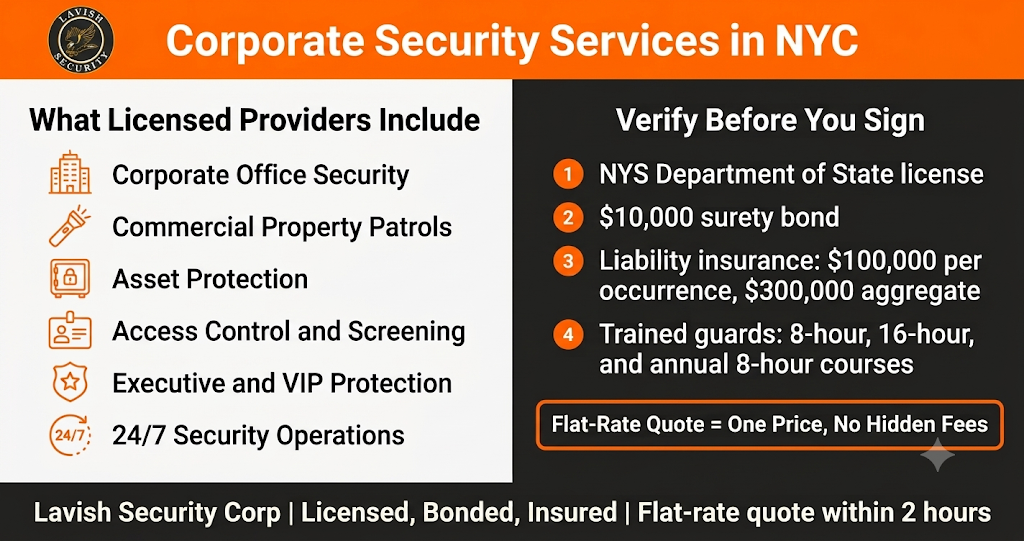
A corporate security program can draw on these components:
- Corporate office security
- Commercial property patrols
- Asset protection services
- Access control and screening
- Executive and VIP protection
- 24/7 security operations
What New York State Requires of Licensed Providers
The New York State Department of State requires a watch, guard, or patrol agency to file proof of a $10,000 surety bond. An agency that employs security guards must also file liability coverage of at least $100,000 per occurrence and $300,000 in the aggregate.
The Department requires that coverage include false arrest or false imprisonment, malicious prosecution, libel, slander, and violation of the right to privacy.
An agency may not employ a guard until that coverage is on file. The employer must also register each guard with the Department’s Division of Licensing Services.
The Department of State training matrix requires unarmed guards to complete an 8-hour pre-assignment course, a 16-hour on-the-job course upon employment, and an 8-hour annual in-service course.
Why Gaps in Security Coverage Create Liability
Quick Answer: Property owners who know of crime risk on their premises can face negligence claims. Citywide crime is falling, yet thousands of major crimes still occur every month.
What Property Owners Owe When Coverage Fails
In Nallan v. Helmsley-Spear, decided in 1980, New York’s Court of Appeals found that a building’s history of criminal activity can create a duty for the owner to take reasonable protective measures. That duty covers foreseeable crime by third parties.
A duty of reasonable protection starts with what the owner already knows about crime at the property, so a security plan should reflect the site’s actual risk history.
Why Risk Persists Even as Crime Falls
The NYPD reported 96,059 major crimes citywide from January through October 2026, down 6.5 percent from 102,726 in the same period of 2025, including 9,750 in October. The same release reports the fewest shooting incidents and murders on record for the first ten months of a year.
For a business, one disruption can still damage its reputation, create legal trouble, and drive away repeat customers.
Common Misconceptions About Hiring a Corporate Security Provider
Quick Answer: No single guard package fits every site, and an hourly rate does not show a contract’s total cost. Test both assumptions before you compare providers.
Misconception 1: One Standard Package Fits Every Office
A corporate office with controlled visitor access has different security requirements from a commercial property with multiple entrances and after-hours operations.
Ask whether the provider will customize its security plan to your property’s layout, operating hours, staffing requirements, and risk profile.
You should also request the agency’s license, proof of its surety bond, and certificate of liability insurance before proceeding.
Misconception 2: An Hourly Rate Shows the Full Cost
An hourly rate is a unit price, not the total contract cost. The final amount depends on coverage hours, contract duration, staffing requirements, and any separately priced charges.
For example, one security post operating around the clock requires 168 coverage hours each week.
To compare quotes fairly, multiply each hourly rate by the required coverage hours across the contract term. Then account for additional charges and confirm that every provider is quoting the same scope of work.
A flat-rate quote states one price for the agreed coverage instead of requiring you to calculate the total from an hourly rate. However, you should still check what the quoted amount includes and whether additional charges can apply.
How Lavish Security Corp Provides Corporate Security Services
Quick Answer: Lavish Security Corp holds its license from the New York State Department of State and quotes corporate security work at a flat rate with no hidden fees. It replies with a quote within two hours.
Services and Contract Terms
Lavish Security Corp, based in the Bronx, provides corporate office security, commercial property patrols, asset protection, executive and VIP protection, access control and screening, and 24/7 security operations. Coverage reaches Manhattan, Brooklyn, Queens, Staten Island, Long Island, and Westchester County.
The company operates fully licensed, bonded, and insured, with its license from the Department of State’s Division of Licensing Services. Its team brings military and law enforcement experience.
Lavish Security Corp customizes each plan to the client’s site, and contracts run short-term, long-term, single-event, or as permanent site coverage.
How the Flat-Rate Quote Works
Lavish Security Corp quotes corporate security work at a flat rate. The quote carries no hidden fees, and the company replies with it within two hours. Lavish Security Corp has secured 150+ client sites across NYC.
Frequently Asked Questions
Q1. What license must a security guard company hold in New York?
A watch, guard, or patrol agency furnishes guards for hire, and the Department of State licenses it. Lavish Security Corp holds its license from the NYS Department of State, Division of Licensing Services. Ask any provider for its license before you sign.
Q2. What training do NYC security guards complete?
Unarmed guards complete an 8-hour pre-assignment course, a 16-hour on-the-job course within 90 days of employment, and an 8-hour in-service course each year. Lavish Security Corp guards also train in security protocols, emergency response, and CPR and first aid.
Q3. What insurance must a guard company carry?
An agency that employs guards must file liability coverage of at least $100,000 per occurrence and $300,000 in the aggregate with the Department of State. Lavish Security Corp operates fully licensed, bonded, and insured.
Q4. What is a flat-rate security quote?
A flat-rate quote states one price for the coverage you request, so you compare providers by final cost. Lavish Security Corp’s flat-rate quotes carry no hidden fees and arrive within two hours.
Q5. What contract lengths are available?
Contracts run short-term, long-term, single-event, or as permanent site coverage.
Conclusion
Choosing among the best corporate security companies in NYC requires more than comparing hourly rates. Verify each provider’s state license, confirm individual guard registrations, review insurance documentation, and assess whether its security plan addresses your property’s specific requirements.
A clearly defined quote also helps you understand the full scope of coverage before signing. Lavish Security Corp offers customized security plans, flexible contract terms, and flat-rate quotes for businesses across NYC.